
Posters in the aisles, promotional signs on central islands, large printed graphics at service counters. Stores still communicate a great deal through paper: a familiar but static language that has to be printed, distributed and replaced every time a promotion or assortment changes.
With the No Paper project, Nicolis Project supports grocery retailers in turning these spaces into updatable, accessible and interactive touchpoints, managed from a single control centre, with the goal of fully digitalising communication spaces by 2030.
In this article we look at the areas of the store where this evolution is focused, the formats and mounts involved, what SmartDKey adds, and why centralised management makes a difference in terms of effectiveness and efficiency.
TABLE OF CONTENTS
THE SCENARIO
Why static communication is no longer enough
More and more grocery retailers are launching projects to reduce the use of paper in in-store communication by 2030. This is not a one-off intervention but a transformation process made up of several strategic actions, which progressively improve operational efficiency, update information in real time and make communication more effective and engaging.
Customers entering a store expect clear, up-to-date information consistent with what they find online and in the retailer’s app. Paper communication, by contrast, is fixed by nature: it conveys a single message, for a set period, in the same way to everyone.
Every promotion change requires new prints, new installations and staff time. And there is one limit no sign can overcome: space. A sheet of paper can only hold a limited amount of information, which cannot be expanded or listened to.
That is why our approach goes beyond replacing paper with a digital medium: it rethinks every communication surface in the store as a dynamic touchpoint, centrally managed and able to interact with the customer.

LARGE FORMAT
Large-format ESLs for aisles, promotional areas and service counters
The first area concerns in-store signage. Nicolis Project has identified three areas where the No Paper project can make a difference, because they still rely largely on print:
- Sales aisles, with posters and signs highlighting promotions and initiatives;
- Promotional bins and displays on central islands;
- Service counters with large printed graphics, where no Digital Signage system is planned.
For these spaces, Nicolis Project offers large-format electronic labels: the 9.7″ in 4 colours and the 13.3″ in 6 colours. The idea is to bring the same logic that ESLs have already introduced on the shelf to the most visible points in the store. The promotional message is updated remotely, the moment a promotion starts or ends, with no printing and no manual work in each store.

For a format to truly fit into the space, however, it also needs the right mount. That is why our R&D team designs special mounts for aisles, promotional areas and service counters, and is developing a growing range of mounts for the 13.3″, designed for different settings.
The result is promotional communication that is consistent with what customers see on the shelf and on the retailer’s digital channels, and able to adapt to the needs of each individual store.
NFC INTERACTION
SmartDKey and everything a label alone cannot say
The second area does not replace something that already exists: it adds to the ESLs already on the shelf what a label alone cannot offer. SmartDKey is the SDK that integrates into the retailer’s app and, via NFC, turns the electronic label into a digital touchpoint between product, retailer and customer.
By bringing their smartphone close to the ESL, customers access a genuine digital ingredients book: nutritional information, allergens and product traceability, available instantly and without the space limits of a label.
Then there is the voice assistant. Reading label information aloud allows people with visual impairments to access product content easily and independently. Accessibility thus becomes part of the shopping experience, right at the shelf.
Finally, every interaction makes it possible to gather data on customers’ real preferences: valuable knowledge for designing more relevant communications and promotions, displayed directly on the smartphone.

THE PASSPORT
The Digital Product Passport comes to the shelf

The third area looks at a change that will affect many product categories in the coming years: the Digital Product Passport (DPP). Established by Regulation (EU) 2024/1781 and introduced gradually, it gives each product a unique identity, linked to information such as origin, composition and durability.
Customers can access this information with their smartphone, through a 2D code based on international standards such as GS1 Digital Link. The store’s digital touchpoints thus become a natural bridge to the passport:
- On electronic labels, by tapping the smartphone via NFC or scanning the QR code;
- On Digital Signage devices, by scanning the QR code displayed on screen.
Passport information is no longer confined to the packaging: it becomes part of the shopping experience, at the moment the customer chooses.
WINE INFORMATION
An example already in place: wine information via QR code

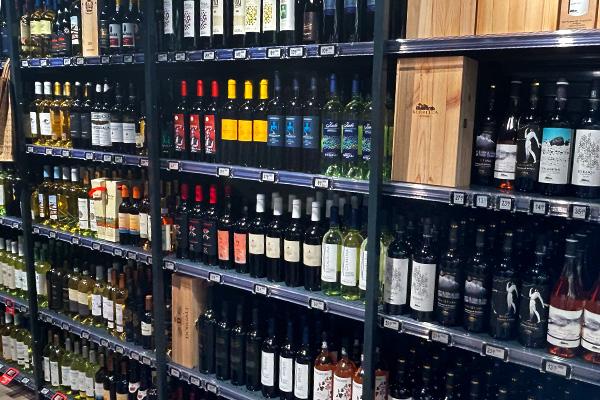
There is one department where product communication via QR code is already an everyday reality: wine. Since 8 December 2023, under Regulation (EU) 2021/2117, producers must provide the list of ingredients and the nutrition declaration, and may also make them available electronically, through a QR code on the label. An option that EU legislation confirmed and strengthened in 2026.
Some of the retailers we work with already use wine information QR codes in their stores. With our ESLs, equipped with NFC connectivity and QR codes, customers can access the same content directly from the shelf label, without having to look for the code on the bottle. On the department’s Digital Signage displays, the same access is possible by scanning a QR code on screen.
A small gesture that makes choices better informed and anticipates what the digital passport will bring, in the future, to many other categories.
CENTRALISED MANAGEMENT
One platform for every communication space

More dynamic surfaces mean more opportunities to communicate, but also more devices to manage: ESLs on the shelf, 9.7″ and 13.3″ formats in aisles and promotional areas, Digital Signage in departments. Without a single control centre, every new touchpoint would become yet another system to update, monitor and maintain.
This is the role of Profimax Cloud, Nicolis Project’s Native Omnichannel Platform, which manages electronic labels and Digital Signage remotely and centrally, from headquarters to each individual store. From a single software platform, prices, promotions and content are scheduled for every device, keeping the brand consistent across aisle, promotional area and department.
The advantage is twofold.
- Effectiveness: every message reaches the right place at the right time.
- Efficiency: a single management tool reduces manual work and operating times, and is designed to optimise TCO.
Profimax Cloud also collects customer interactions with ESLs via NFC and QR code, returning useful data to improve in-store communication over time.
KEY TAKEAWAYS
What to take away from this article

UPDATABLE COMMUNICATION
With 9.7″ and 13.3″ ESLs and their dedicated mounts, promotions in aisles, on islands and at service counters change remotely, at the right moment, with no new prints.

INFORMATION WITHOUT SPACE LIMITS
With SmartDKey, ingredients, allergens and traceability are just a smartphone tap away.

ACCESSIBILITY AT THE SHELF
The voice assistant makes product content accessible to people with visual impairments too.

READY FOR THE PASSPORT
ESLs and Digital Signage connect the shelf to digital product information via NFC and QR code.

MORE SURFACES, MORE OPPORTUNITIES TO COMMUNICATE
With Profimax Cloud, all dynamic surfaces are managed from a single software platform, with no added complexity.
IN CONCLUSION
Every surface in the store can communicate more
No Paper does not mean giving up physical communication, but giving it new possibilities. Large-format ESLs make aisles, promotional areas and service counters dynamic; SmartDKey brings to the shelf everything a label alone cannot say; the Digital Product Passport paves the way for direct, immediate access to product information.
Three different areas, managed from a single control centre: a store where every square metre communicates in an up-to-date, accessible and consistent way. Where every store becomes a new way of experiencing retail.
We stand alongside grocery retailers and entrepreneurs to support them on the journey towards the No Paper model, with the goal of fully digitalising communication spaces by 2030.
Want to find out how to make the communication spaces in your store dynamic?
Let’s design the right solution together. Contact us
Related Articles

Marketing Strategies for Hardware Stores: Innovation is Digital
Marketing Strategies for Hardware Stores: Innovation is Digital
Mass-market Retail Sales: solutions for increasing margins and reducing costs
Mass-market Retail Sales: solutions for increasing margins and reducing costs

Integrated systems for retail: why electronic shelf labels and Digital Signage work better together